Introduction
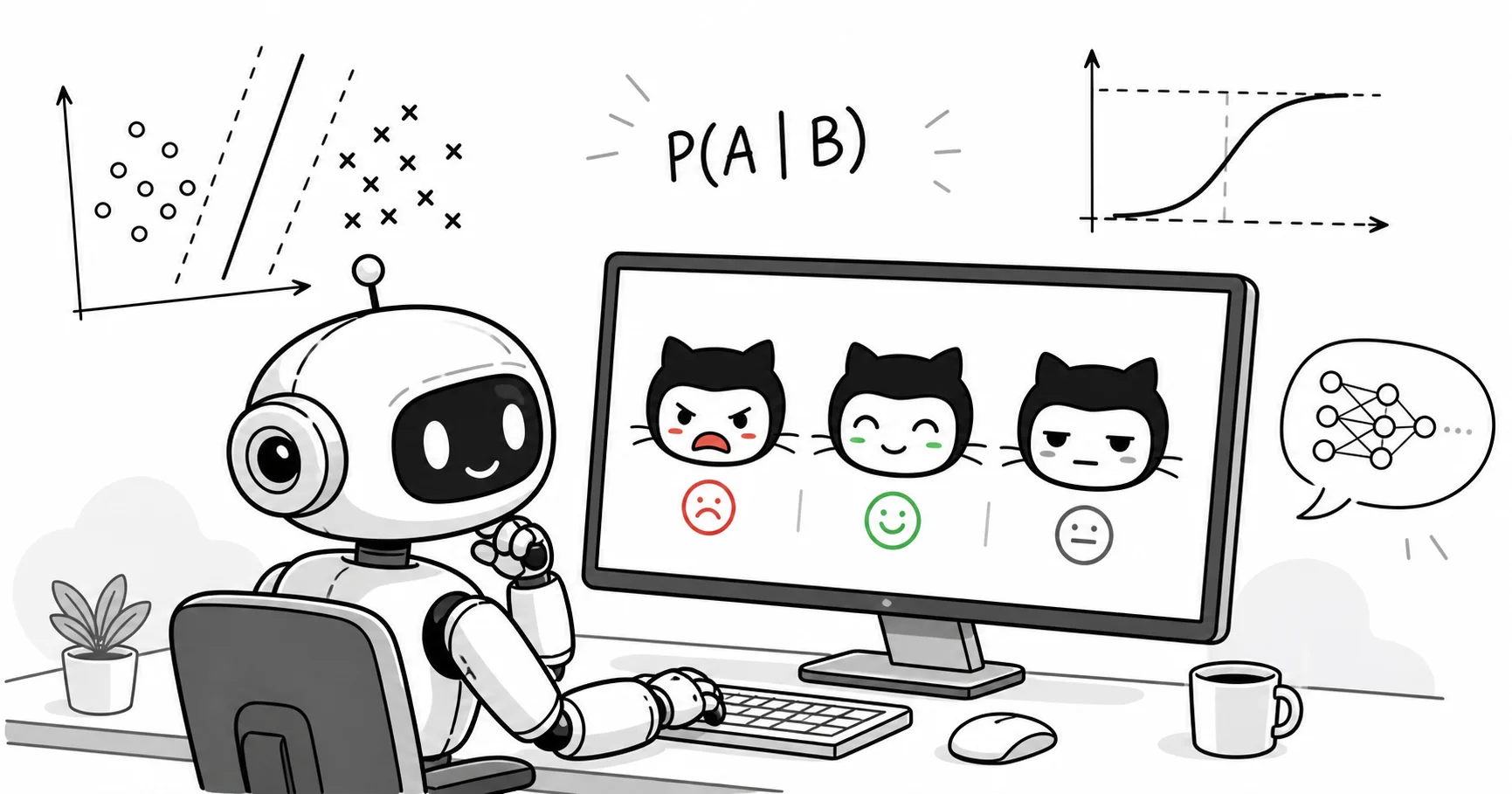
To improve the GitHub user experience in a visually appealing way—and qualify for the developer program along the way—I decided to develop a sentiment analyzer for repository issues. The idea was to automatically classify issue comments and descriptions as positive, negative, or neutral, allowing developers to better prioritize their responses and actions.
Sentiment classification is a common use case in AI-based text analysis, and several techniques and tools can be used for this purpose. Below, I describe the process I followed to develop this sentiment analyzer, the challenges I faced, and the solutions I implemented.
Table of contents
Table of contents
Requirements analysis
The first step was to define the project requirements. I needed a tool capable of analyzing GitHub issue comments and descriptions and classifying them into sentiment categories. I also wanted the tool to work in real time through an attractive, easy-to-use web interface. It was important for it to be free and open source, so that other developers could contribute to and improve it. The software and cloud resources also had to be free and legally accessible, since I had no budget for this project.
This limited the tools and services I could use, but as Jean-Michel Jarre says, “creativity comes from constraints.”
For the initial MVP (Minimum Viable Product), I decided to focus on issue descriptions. They are easier to retrieve and analyze than comments, and they usually contain the most relevant information about an issue. The functionality could later be expanded to include comments.
For the analysis, I ruled out large language models (LLMs), since most services that provide them charge for usage, and I did not want to depend on an external service whose policies or prices could change in the future. As mentioned before, the budget was USD $0.00, so I could not afford an LLM service for this project. Instead, I chose a free, open-source natural language processing library that could run locally or on my own server. This gave me more control over the process and allowed me to customize the model for my needs.
In classical machine learning, several techniques can be used for sentiment analysis, including Naive Bayes and SVM. They rely on supervised learning and therefore use labeled datasets, or corpora. These models are lighter and faster than LLMs and can be trained with smaller datasets tailored to the GitHub issue domain.
The three algorithms used have different characteristics:
| Model | Text representation | Classification criterion | Main advantage | Main limitation |
|---|---|---|---|---|
| Naive Bayes | Presence of normalized words with Porter stemming | Probability of each class based on feature frequency | Simple and fast training and inference; works well as a baseline | Assumes independence between words and loses contextual relationships |
| Linear SVM | Sparse, L2-normalized TF-IDF vectors | Three one-vs-rest classifiers optimized with hinge loss | Often separates high-dimensional text well and produces a portable model | Its margins are not probabilities; the displayed percentage is relative confidence |
| Logistic regression | The same TF-IDF vectors used by SVM | Multiclass softmax function over linear scores | Produces comparable scores across the three classes while keeping inference lightweight | Remains a linear model and cannot understand sarcasm, complex negation, or long-range context |
Another important consideration was where the analyzer would run. Once again, the budget ruled out cloud services that charge by usage, so I decided to run the analyzer on a Cloudflare Worker. Cloudflare offers a free plan with some limitations, but it is perfectly suitable for this project, especially as an MVP. Cloudflare Workers also run JavaScript at the network edge, allowing the analyzer to be closer to its users and provide better latency and performance.
Svelte and SvelteKit are an excellent option for Cloudflare Workers. They make
it possible to create modern, reactive web applications with excellent
performance and a very small bundle. SvelteKit also has an official Cloudflare
adapter, @sveltejs/adapter-cloudflare, which simplifies application deployment
and management. I therefore chose SvelteKit as the framework for the sentiment
analyzer and Svelte as the component layer for its user interface.
However, using JavaScript—or TypeScript—to develop the sentiment analyzer also imposes significant constraints. Most sentiment-analysis libraries are written in Python and cannot run directly on a Cloudflare Worker. I therefore had to find a free, open-source sentiment-analysis library written in JavaScript or TypeScript and, above all, compatible with Cloudflare Workers. Fortunately, there are some options, such as Natural, which provides a Naive Bayes classifier and other text-analysis techniques. Natural depends on Node APIs, so I reserved it for the offline trainer. The Worker does not load the library; it consumes the model already serialized as JSON and performs inference in pure TypeScript.
The main alternatives I evaluated can be summarized as follows. None of them provides sentiment analysis by itself: they all require labeled text and a preliminary tokenization and feature-extraction stage.
| Library | Supervised models | Text preparation | Advantages | Limitations for this project |
|---|---|---|---|---|
| Natural | Naive Bayes and logistic regression | Includes tokenization, stemming, and TF-IDF | NLP-oriented API, straightforward training, and JSON-serializable models | Depends on Node APIs; best used in the trainer, with inference reproduced in pure TypeScript |
ML.js (ml-naivebayes and ml-svm) | Gaussian or multinomial Naive Bayes and SVM | Requires converting text into numeric vectors | Small, independent packages with exportable models | ml-svm is an educational, binary implementation; multiclass classification requires an additional strategy |
| libsvm-js | Classification and regression SVMs with linear, polynomial, RBF, and sigmoid kernels | Requires vectors such as TF-IDF | Full LIBSVM implementation with multiclass support, cross-validation, and serialization | Uses WebAssembly and is heavier than linear inference written specifically for the Worker |
| TensorFlow.js | Dense, convolutional, and recurrent neural networks, among others | Requires designing the text encoding or tokenization | Maximum flexibility, with training in either the browser or Node.js | Greater complexity, bundle size, and execution cost for a small classical classifier |
The final question was the training dataset. Having ruled out paid hosted inference services, such as OpenAI, and pretrained Hugging Face Hub models that were too heavy for a Worker, I needed a free dataset containing examples of GitHub issue comments and descriptions. Fortunately, a dataset called
GitHub Gold Standard
contains more than 7,000 GitHub comments and issue descriptions labeled by polarity—positive, negative, or neutral. Despite its limitations, it is ideal for training a sentiment-analysis model specific to the software-development domain, which is my use case.
Before choosing it, I compared the Gold Standard with
rsl-ai/github-issues,
another corpus available on Hugging Face:
| Characteristic | GitHub Gold Standard | rsl-ai/github-issues |
|---|---|---|
| Size | 7,122 comments | 1,000 issues and pull requests |
| Unit of analysis | Commit and pull request comments | Complete record for each issue or pull request |
| Available text | Comment text | Title, body, and comments, plus GitHub API metadata |
| Sentiment labels | Yes: positive, neutral, and negative | Does not include polarity or sentiment |
| Annotation type | Manually labeled with disagreement resolution | Data collected directly from the GitHub API |
| License | CC BY 4.0 | MIT for the dataset; source data retains the terms of GitHub and each repository |
| Best suited for | Supervised training and evaluation of sentiment classifiers | Issue analysis, summarization, enrichment, or creation of a new labeled corpus |
Although rsl-ai/github-issues better reflects the complete structure of an
issue, it cannot be used directly to train the three classifiers because it
does not contain the variable they must learn to predict. Its texts would have
needed manual labeling, or provisional labels followed by validation. For this
MVP, the Gold Standard provided the shortest path to a reproducible supervised
model.
System architecture
The first architectural decision was to divide the system into two parts that do not need to run at the same time: model training and the application that uses those models to classify issues. Training is a relatively intensive process, but it only runs occasionally on a local computer. Inference, on the other hand, must be fast and available whenever a user queries a repository.
This separation kept the Worker small. Nothing is trained in production, the dataset is never loaded there, and neither Python, an external service, nor a native library is required. The Worker receives text, loads a JSON file with the model parameters, and performs classification in TypeScript.
At a high level, the architecture looks like this:
flowchart LR
    subgraph Training[Offline training]
        Dataset[GitHub Gold Standard CSV]
        Trainer[TypeScript trainer]
        Bayes[Bayes model]
        Logistic[Logistic regression model]
        SVM[SVM model]

        Dataset --> Trainer
        Trainer --> Bayes
        Trainer --> Logistic
        Trainer --> SVM
    end

    subgraph Cloudflare[Cloudflare application]
        UI[SvelteKit interface]
        API[GET /api/issues]
        Cache[Cloudflare Cache API]
        R2[(Private R2 bucket)]
        Inference[Inference engine]

        UI <--> API
        API <--> Cache
        API --> Inference
        R2 --> Inference
        Inference --> API
    end

    API <--> GitHub[GitHub Issues API]
    Bayes --> R2
    Logistic --> R2
    SVM --> R2
Training outside the Worker
The repository contains a TypeScript command-line program that reads the GitHub Gold Standard dataset. Each row includes text written by a developer and a polarity: positive, neutral, or negative. Before passing a row to a classifier, the program validates its structure with Zod, normalizes the label, and removes fragments that could introduce noise, such as URLs, commit hashes, and code blocks.
The trainer can produce three different models:
- Naive Bayes, using the classifier from the Natural library.
- Multiclass logistic regression, trained on sparse TF-IDF vectors.
- Linear SVM, also trained on TF-IDF, with a one-vs-rest strategy for the three sentiment classes.
For the linear models, I built a shared TF-IDF representation. The vocabulary keeps up to 10,000 terms and discards those appearing in fewer than two documents. Each text is transformed into a sparse vector and L2-normalized. As a result, the model stores only the vocabulary, IDF values, labels, weights, and biases required to repeat the calculation during inference.
Each training run produces a JSON file:
github-sentiment-bayes-model.jsongithub-sentiment-logistic-model.jsongithub-sentiment-svm-model.jsonThese files are the contract between the two halves of the system. The trainer can evolve without becoming part of the deployment, while the Worker only needs to understand the serialized format. Once generated, the models are uploaded manually to a private Cloudflare R2 bucket with Wrangler.
The classification application
The visible part of the system is a SvelteKit application deployed as a
Cloudflare Worker. Svelte handles the interface, while SvelteKit provides the
GET /api/issues endpoint, which acts as the boundary between the browser,
GitHub, the cache, and the models.
When a user enters a repository URL, selects a classifier, and presses the analysis button, the browser sends three parameters to the endpoint:
- The repository, as a GitHub URL or in
owner/repositoryformat. - The selected model:
svm,bayes, orlogistic. - The requested results page.
The endpoint validates these values before performing any external operation. The page must be between 1 and 40, the model name must belong to the supported list, and the repository must contain exactly two segments: owner and name. This produces clearer error messages and prevents arbitrary input from being used to construct the GitHub request or cache key.
The complete path of a request is as follows:
sequenceDiagram
    actor User
    participant UI as SvelteKit in the browser
    participant API as Worker /api/issues
    participant Cache as Cache API
    participant GitHub as GitHub Issues API
    participant R2 as R2 MODELS
    participant Model as TypeScript inference

    User->>UI: Selects repository and model
    UI->>API: GET repository, model, and page
    API->>API: Validates parameters
    API->>Cache: Looks up the issue page

    alt Page is not cached
        Cache-->>API: MISS
        API->>GitHub: Requests 25 open issues
        GitHub-->>API: Issues and pagination signal
        API->>Cache: Stores the page for 24 hours
    else Page is cached
        Cache-->>API: HIT with issues
    end

    API->>R2: Loads model if it is not in memory
    R2-->>API: JSON model
    API->>Model: Classifies each description
    Model-->>API: Sentiment and relative confidence
    API-->>UI: Classified issues
    UI-->>User: Negative, neutral, and positive kanban
Retrieving and caching issues
The GitHub API returns issues and pull requests from the same endpoint. Since
this project focuses on issues, the Worker removes any item containing the
pull_request property. It also verifies that a title exists and that the
resulting URL belongs to https://github.com/.
Each request retrieves up to 25 open items. To constrain response size and inference work, only the title, URL, and first 255 characters of the description are retained. These fields form a minimal representation of each issue, and the page is stored in the Cache API for 24 hours.
One detail matters: the cache key includes the repository and page, but not the model. The cache stores data retrieved from GitHub before classification. Sentiment is calculated after that data is retrieved. Consequently, users can switch from SVM to Bayes or logistic regression without triggering another GitHub request or keeping three copies of the same page.
Cache writes are passed to waitUntil, so the Worker does not need to delay the
response while storing the copy. The key also includes a schema version. If the
shape of cached data changes later, incrementing that version prevents old
entries from being read with an incompatible structure.
Loading and running the models
The R2 bucket is connected to the Worker through the MODELS binding. Because
this is a private binding, JSON files are never exposed directly to the browser.
The endpoint maps the user’s selection to its corresponding key, downloads the
object, and validates its structure before use.
For linear models, it verifies that the vocabulary, IDF values, weight matrices, biases, and labels have compatible dimensions. For Bayes, it checks the feature tables and totals for each class. It also rejects models exceeding the expected maximum size. A missing or malformed file therefore becomes a controlled error instead of silently producing an incorrect classification.
Once validated, the model is retained in a promise shared by requests handled by the same warm Worker instance. This avoids reading and parsing the same JSON for every page. If loading fails, the promise is removed so a later request can retry; otherwise, a transient R2 failure would remain cached for the lifetime of the instance.
Inference reproduces the training transformations. SVM and logistic regression clean and tokenize the text, build a sparse TF-IDF vector, and calculate a linear score for each label. Bayes uses the features present and accumulates probabilities in log space to avoid numerical problems. Finally, a softmax function transforms the scores into relative values that the interface can display as confidence.
Presenting the results
The endpoint response contains the repository, page, cache status, and a list of issues with their prediction and confidence. Svelte distributes that list across three kanban columns: negative, neutral, and positive. Each card displays the title, a description excerpt, the confidence percentage, and a link to the original issue.
Results load incrementally. An IntersectionObserver watches an element at the
end of the page and requests the next block before the user reaches it. This
provides infinite scrolling without pagination buttons and without downloading
every repository issue at once.
The sentiment distribution can be highly uneven. In a repository with many neutral results, for example, a newly added positive or negative card could appear outside the visible area and go unnoticed. To prevent this, the interface checks whether a card is visible in the destination column. If none is visible, it temporarily presents the new issue with the same width and position as that column, holds it for two seconds, and then slides it upward before adding it to the stack. The animation respects the system preference for reduced motion.
Conclusions
With this architecture, the browser focuses on interaction, the Worker coordinates and classifies, the Cache API reduces repeated GitHub requests, and R2 keeps the models out of the bundle. The trainer remains entirely outside the request path. For an MVP with a USD $0.00 budget, this separation provides a reasonable balance of cost, speed, and maintainability.
The GitHub Gold Standard dataset is sufficient to train a sentiment-analysis model for the software-development domain, although it has limitations. Despite the number of examples, the diversity of projects and programming languages is limited, and comment polarity can be subjective. The model may therefore fail to generalize well to every GitHub repository, and fine-tuning or retraining with newer or more specific data may be required to improve accuracy. Sentiment classification is also a complex problem, and determining the polarity of a comment or description is not always straightforward. For example, the trained models struggle to identify sarcasm, irony, or humor and may misinterpret double negatives or ambiguous expressions. Their results should therefore be treated with caution.
A future improvement could involve using a Transformer-based model, such as BERT, or a large language model (LLM) to classify sentiment.
Links
References
Cortes, C., & Vapnik, V. (1995). Support-vector networks. Machine Learning, 20, 273–297. https://doi.org/10.1007/BF00994018
Coutinho, D., Braga, B., Canuto, T., Pereira, J. A., Assunção, W. K. G., Steinmacher, I., Gerosa, M., & Garcia, A. (2026). Leveraging large language models for sentiment analysis in GitHub pull request discussions. Empirical Software Engineering, 31, Article 140. https://doi.org/10.1007/s10664-026-10868-6
Cox, D. R. (1958). The regression analysis of binary sequences. Journal of the Royal Statistical Society: Series B (Methodological), 20(2), 215–242. https://doi.org/10.1111/j.2517-6161.1958.tb00292.x
Devlin, J., Chang, M.-W., Lee, K., & Toutanova, K. (2019). BERT: Pre-training of deep bidirectional transformers for language understanding. In Proceedings of the 2019 Conference of the North American Chapter of the Association for Computational Linguistics: Human Language Technologies, Volume 1 (Long and Short Papers) (pp. 4171–4186). Association for Computational Linguistics. https://doi.org/10.18653/v1/N19-1423
Novielli, N., Calefato, F., Dongiovanni, D., Girardi, D., & Lanubile, F. (2020a). A gold standard for polarity of emotions of software developers in GitHub [Data set]. figshare. https://doi.org/10.6084/m9.figshare.11604597
Novielli, N., Calefato, F., Dongiovanni, D., Girardi, D., & Lanubile, F. (2020b). Can we use SE-specific sentiment analysis tools in a cross-platform setting? In Proceedings of the 17th International Conference on Mining Software Repositories (pp. 158–168). Association for Computing Machinery. https://doi.org/10.1145/3379597.3387446
Webb, G. I., Boughton, J. R., & Wang, Z. (2005). Not so naive Bayes: Aggregating one-dependence estimators. Machine Learning, 58(1), 5–24. https://doi.org/10.1007/s10994-005-4258-6