Paola Hermosín
A few days ago, Paola Hermosín, a music YouTuber I follow, who makes very interesting videos and plays guitar very well, published this video about a very famous song by Francis Cabrel, a well-known French singer-songwriter:
The video tells the story of the song “Je l’aime à mourir” (“La quiero a morir”), published on Cabrel’s 1979 album “Les Chemins de traverse”, but with a very curious twist I didn’t know about, involving Mexican diva María Félix, an unrequited love, Verónica Castro, Paris, and a poem.
Table of contents
Table of contents
The legend
During the 1980s and 1990s, Mexican artist Verónica Castro hosted several nighttime variety shows on Channel 2 (later “Canal de las Estrellas”) on Televisa. These programs usually featured a famous singer as a guest for the entire broadcast. On November 27, 1991, on the show “La Movida,” she interviewed legendary María Félix.
The story, as told by Félix herself, says that one of her admirers, named Jean Cau, who was secretary to Jean-Paul Sartre, wrote her a poem or letter when his love was not returned. Later, Cau allegedly sold the rights to the text to Francis Cabrel because he was having financial problems. Cabrel would later use it as the basis for the lyrics of “Je l’aime à mourir”.
The French connection
This story has apparently spread widely in Latin America as a legend. However, there are no Francophone references to it. On the contrary, authorship of the lyrics is fully attributed to Cabrel, with some references suggesting he was inspired by his wife.
A look back at Francis Cabrel’s first hit, “Je l’aime à mourir,” dedicated to his wife Mariette and taken from his second album “Les chemins de traverse.” […] dedicated to his wife Mariette, it has become the declaration of all lovers who sing it in unison.
— Je l’aime à mourir”, une déclaration d’amour enregistrée in extremis
“Je l’aime à mourir was composed in one hour,” its author recalled in January 1984 in the magazine Guitares et claviers. “A friend came to see me in the afternoon and showed me a reverse-picking guitar technique. He left, and around nine, I amused myself practicing that technique. By ten, I had already finished the song. By then the album was already done; it had ten tracks, but since there were three studio days left, we added the song at the last minute.”
I love it; it came to me in just a few hours. It was one afternoon. I was already living in Paris because I had been told I lived too far from the center of the action. So I was in a Paris apartment, and some guitarist friends from the provinces came over. I was working on guitar using Dadi’s method. Marcel Dadi had published a method for people who can’t read music. It was called tablature. And there I was, ting diguidin diguidin diguidin. I was doing my best Marcel Dadi imitation. I was playing a chord in an arpeggio, and my guitarist friend said to me: “You know you can also invert that arpeggio.” And suddenly, it started [singing]. [Laughter]. And the song emerged. It was 3 p.m., the music arrived, and my friends left. By 7 p.m., I had finished, because the lyrics were already waiting for music. I had already written some key lines of the song. And then, during the afternoon, the song was written.
— “Un cadeau formidable” : Francis Cabrel évoque son tube “Je l’aime à mourir” repris par Shakira
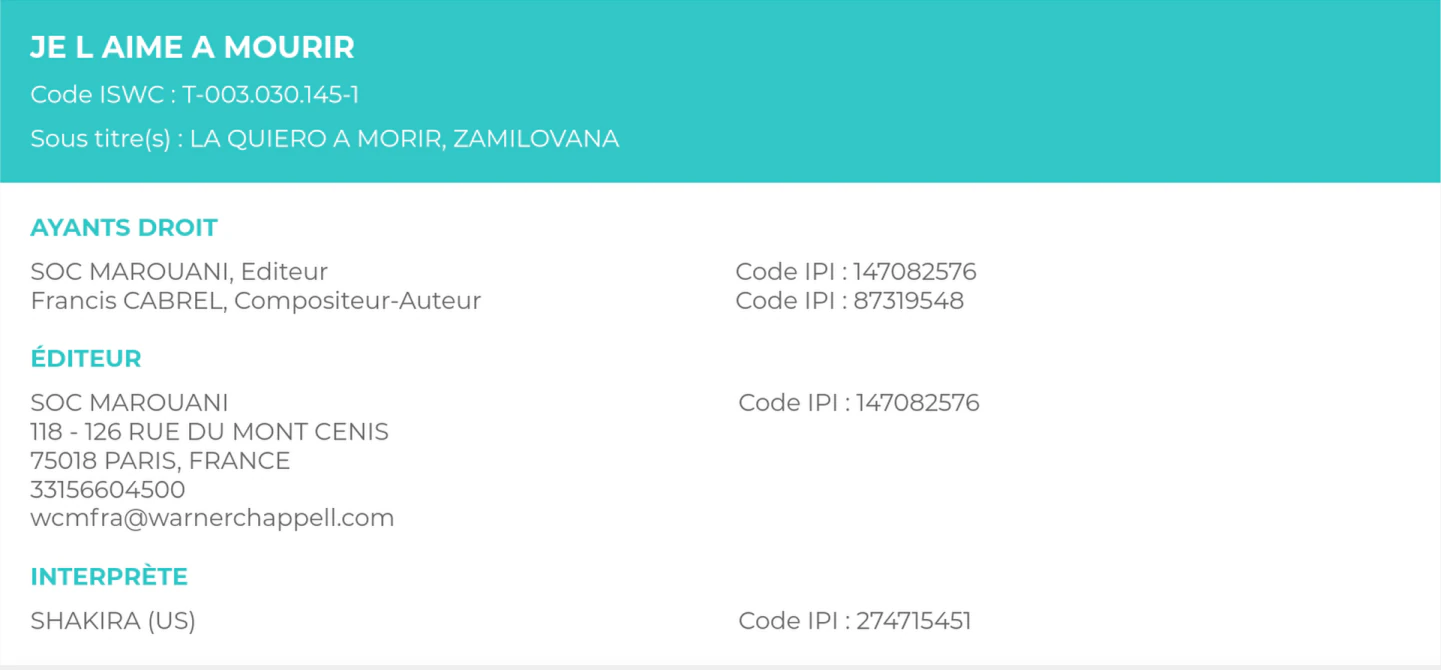
Interestingly, Cabrel commissioned composer Luis Gómez Escolar to write the lyrics for the Spanish version, “La quiero a morir,” which Cabrel himself released in 1980 and which has been performed by many Spanish-speaking singers, from Raphael to Shakira.
In any case, you can listen to the story and the song (in French!) in María Félix’s own voice here:
YouTube videos embedded as clips to illustrate the article.