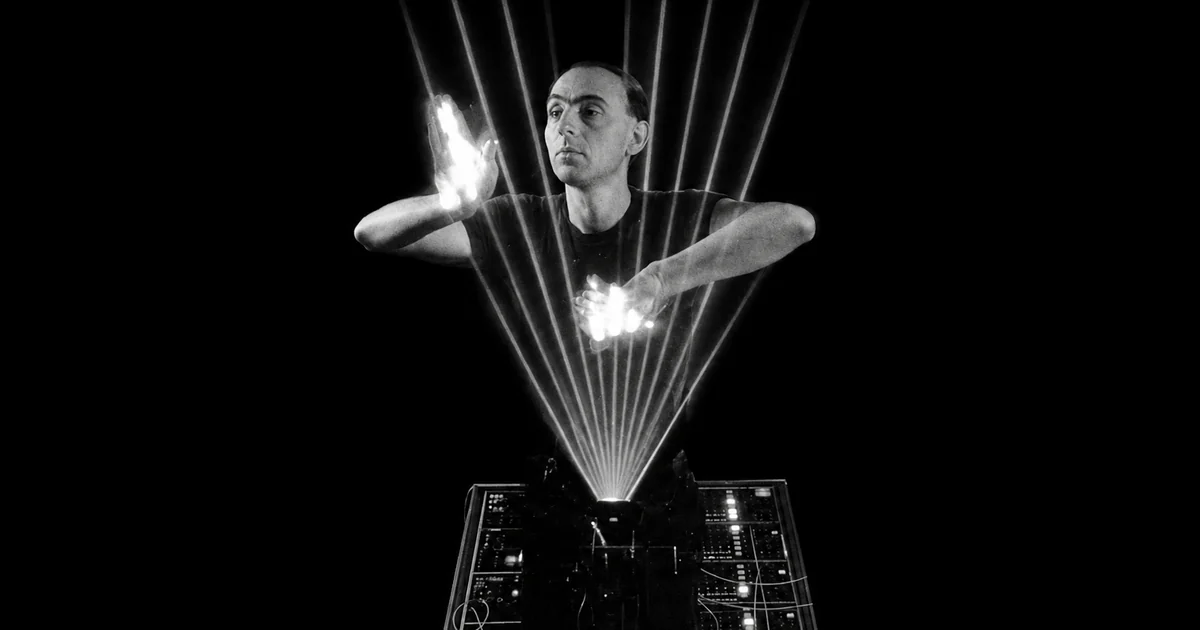
The laser harp
Electronic music — that is, music made with instruments that use electricity as their power source — appeared, unlikely as it seems, in the late nineteenth and early twentieth centuries. One of the first electronic instruments was the theremin, invented by the Russian Lev Termen in 1920.
Jump to the 1970s. The first synthesizers are developed, and with them electronic music begins to reach a general audience, beyond the experimental scene. Groups such as Kraftwerk and Tangerine Dream emerge, reference points for the genre. And of course a regular guest on this blog, Jean-Michel Jarre, has his first hit in 1976 with the album Oxygène, which is turning 50 right about now. What marked the live shows of these seminal groups, though, was the lack of interaction with the audience. The musicians stood behind their synthesizers, and the audience, however moved, could not interact with them. In fact, they often appeared motionless, or with their backs to the crowd, which put a barrier between the artist and the audience.
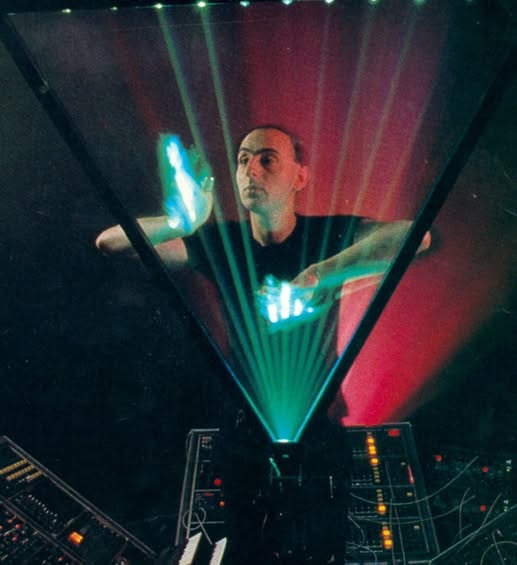
It was in this context that Bernard Szajner, a French artist, decided to create an instrument that would break that barrier. In 1980 Szajner invented the laser harp (Syringe), an instrument that uses beams of light to “trigger” sounds. Musicians could play the light with their hands, creating a visual and sonic experience the audience had not seen before. I say trigger because the beams do not produce the sounds by themselves: interrupting a beam activates a sensor, which produces the corresponding sound through a synthesizer. The audience could thus see the music being generated in real time, and the musicians could interact with their audience in an entirely new way.
Michel Geiss, a sound engineer and collaborator of Jarre’s, was one of the first to see the potential of the laser harp. Geiss discovered the instrument in 1980 during a piece by Pierre Henry presented at the Salle Favart of the Opéra-Comique, Les Noces chymiques. Szajner had also created a spectacular effect: cones of light that followed the dancers’ movements.
Geiss introduced the inventor and his instrument to Jarre, who was very interested in the idea of playing light and making music in such a visual way. Jarre had always thought that live performances should be a visual spectacle, not just a group of musicians playing robotically, and Szajner’s laser harp gave him the chance to take that idea further. During his tour of China, Jarre used the laser harp in several performances, and the audience was fascinated.
The inventor and the artist
Besides being an inventor, Szajner was a talented musician and visual artist. His music, which combined electronic, rock and experimental elements, was innovative and ahead of its time. Here is a sample of some of his albums:
Geiss comments: “of Jewish descent, Bernard was first a victim of Nazi ideology in Germany, and then of antisemitism in France upon arrival”.
Bernard Szajner was born on 27 June 1944 in Grenoble, into a family of Polish Jews who had passed through Germany before settling in France. He was born under the false name Wolf and spent his first months hidden in a cellar: by day, only the light from the basement window; at night, none.
Around 1969 he started in audiovisual work with Patricia Negro, his business partner, and two Kodak Carousel projectors. Those experiments led to the light shows for Magma and Gong. By May 1975 the rig already used several helium-neon lasers, at the Kinopanorama in Paris, with Tim Blake on synthesizer. At the end of that year they founded Laser Graphics, the company devoted to stage uses of the laser. With it they worked on The Who’s European tour (1975), on the Go concerts —Stomu Yamashta and Stevie Winwood— at the Royal Albert Hall and in Paris (1976), for a month at Saint-Eustache (December 1976) and at the Paris Planetarium (May 1977). There were also commissions for Cartier and Renault. In Les Noces chymiques the laser is not credited under his name, but as Groupe Laser Graphics.
The music came by the same path. If the bands treated light as an effect, he decided to compose what would accompany it. Between 1979 and 1983 he released Visions of Dune (1979, credited as Zed), Some Deaths Take Forever (1980, conceived in part as the soundtrack of an Amnesty International short film), Superficial Music (1981) and Brute Reason (1983, Island, with lyrics by Howard Devoto). In parallel, with Karel Beer, he formed The (Hypothetical) Prophets (Wallenberg, 1982). At the end of the decade he left the industry and returned to image, theatre and other interactive instruments.
Bernard Szajner, musician and visual artist, died on 31 August 2026. His legacy, however, endures in electronic and experimental music, and his laser harp remains a symbol of innovation and creativity in music.
Further reading
- Concert Review: Bernard Szajner (Muzines, 1983)
- Laser Graphics (Sound International, June 1978)
- Bernard Szajner: Biography (LTM Recordings)
- Mort de Bernard Szajner, musicien lumineux qui inventa la harpe laser (Télérama, 2026)