Context
In 1985, Jean-Michel Jarre (a regular subject of this blog) and Francis Dreyfus were contacted by the director of the Houston Grand Opera (possibly maestro John DeMain) with a proposal for a concert to celebrate the 150th anniversary of Texas and Houston, as well as the 25th anniversary of NASA. NASA also joined the initiative and contacted Jarre (directly or through the event organization) to incorporate its anniversary into the program. In other words, this was not just an idea from Jarre or the Houston Grand Opera: the agency expressly requested that the concert include the commemoration of the Lyndon B. Johnson Space Center anniversary in Houston.
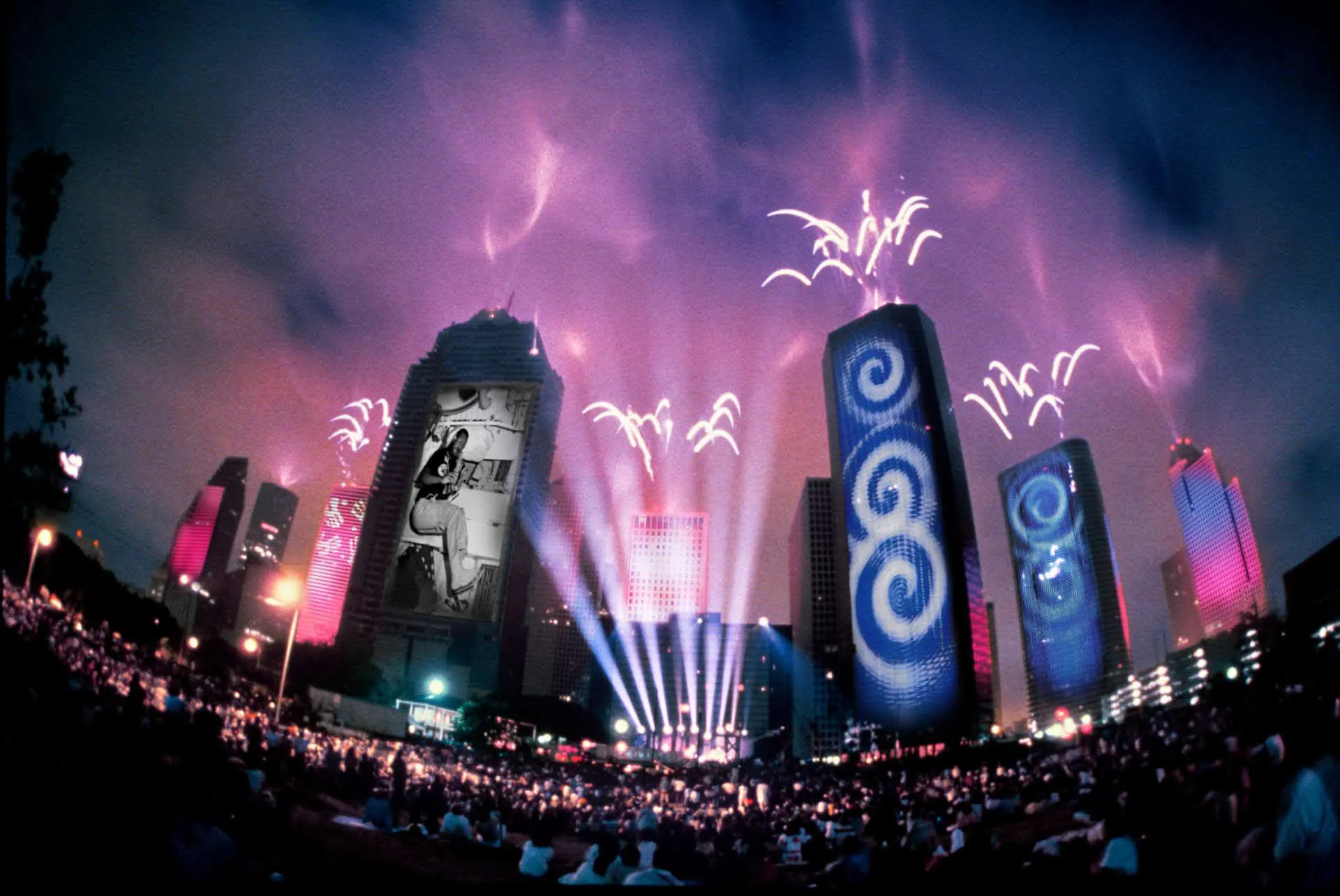
Jarre initially hesitated, but accepted after visiting the city and being impressed by its skyline. The event took place on April 5, 1986, as “Rendez-vous Houston: A City in Concert”, with an estimated audience of more than 1.3 million people, which earned Jarre one of his many entries in the Guinness World Records.
This was the first in a series of Jarre mega-concerts, known as “Cities in Concert”, which used the buildings of different cities as a backdrop for projections on giant screens, enormous fireworks displays, searchlights and laser beams.
One of the central ideas of the project was that NASA astronaut Ron McNair would perform the first musical recording in space, aboard the STS-51-L mission of the Space Shuttle Challenger. This performance would be recorded and played back during the concert on the giant screen placed atop the Heritage Plaza skyscraper in downtown Houston.
Jean-Michel Jarre’s album Rendez-vous was composed specifically for this project, and included a piece featuring Ron McNair’s solo. It is worth noting that some of his pieces from the 1970s were revisited by Jarre for this album, with different arrangements.
Following the ill-fated launch of the shuttle on January 28, 1986, which caused the death of the entire crew, both Jarre and Dreyfus considered immediately canceling the concert.
However, astronaut Bruce McCandless II and McNair’s own widow called Jarre to ask that the project continue as a tribute to Ron and the rest of the lost crew. Thus, preparations continued.
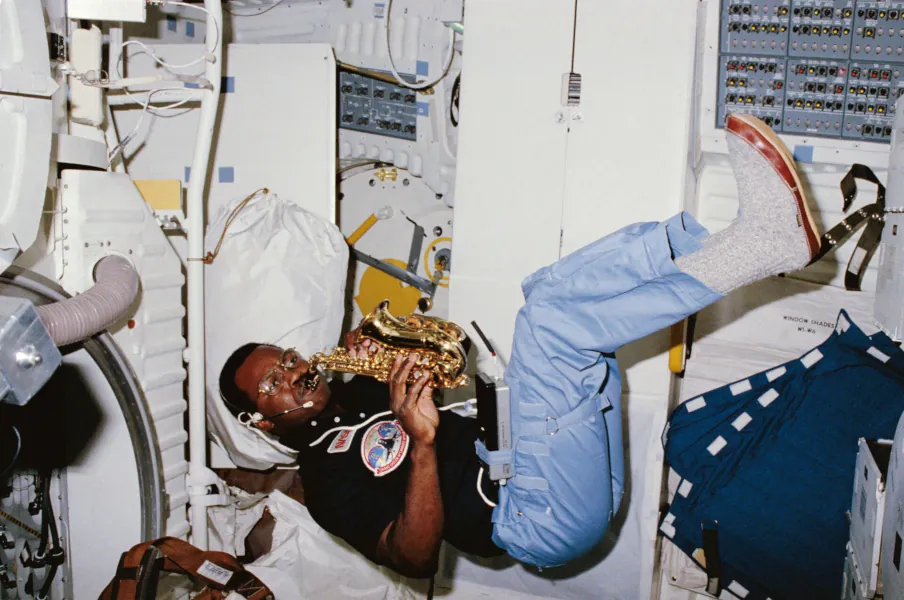
Table of contents
Table of contents
Personnel
Around one hundred and fifty technicians, both French and American, took part in the production team.
Apart from Jarre, the list of performers included:
- Michel Geiss: keyboards.
- Sylvain Durand: keyboards.
- Dominique Perrier: keyboards.
- Francis Rimbert: keyboards.
- Pascal Lebourg: keyboards.
- Jo Hammer: drums.
- Dino Lumbroso: percussion.
- Kirk Whalum: soprano saxophone.
- Christine Durand: soprano.
- The High School for the Performing and Visual Arts: dance.
- The Singing Boys of Houston (93 singers): choir.
- The High School for the Performing & Visual Arts (7 sopranos): choir.
Other names who took part in the project include:
- Francis Dreyfus, Jarre’s manager at the time and head of Disques Dreyfus, played a key role as executive producer and general coordinator. He appears in the credits of the television special and was fundamental in the organization, negotiations, and French production of the project.
- Mark Fisher was the production designer and set designer of the event. Mark Fisher is one of the most important names associated with the concert: he was responsible for the overall design of the stage setup, the integration of Houston’s skyline as a “giant stage”, and the placement of projections, lights and visual elements. He was a highly regarded British designer who collaborated on several of Jarre’s mega-concerts (Houston, Docklands, etc.) and also worked with Pink Floyd and other artists. His work in Houston was key to turning the entire city center into an audiovisual spectacle.
- Harry Golemon, president of the Houston Festival Foundation, played a key role in the organization of the event, which was part of the Houston International Festival. He was a prominent architect in Houston (of the firm Golemon & Rolfe) and was involved in the city’s civic and cultural activities.
- Joanne Adams, part of Houston Mayor Kathy Whitmire’s team, coordinated the city’s participation in the concert. In later interviews (such as in the Houston Chronicle in 2018) she recalled the logistical challenges, uncertain weather and the unexpected impact of the event, including how people stopped their cars on highways to watch it.
- Bob Giraldi directed the video/television special of the concert Rendez-vous Houston: A City in Concert (1986). Bob Giraldi is an American director well known in the 1980s for his music videos and musical productions. Among his most famous works is the iconic music video for Michael Jackson’s “Beat It” (1983), which is part of the album Thriller and is one of the most influential videos in the history of pop.
Stage
The main stage was in front of the Meridien Hotel, and the event transformed the entire downtown Houston into a grand stage with lasers, fireworks and projections on multiple facades. As already mentioned, the Heritage Plaza building served as the giant screen for the concert’s projections.
Problems
In Texas, fireworks are prohibited, so the team needed a special permit to bring them into the state, as well as transporting them under armed escort. To comply with regulations, more than 40 firefighters were also deployed on rooftops from which the fireworks would be launched, as well as at seven nearby buildings.
Before the concert got underway, there was still one more obstacle to resolve. Robert Clayton, chief of the Houston Fire Department, warned Francis Dreyfus that the event had to be suspended due to a change in wind direction, as there was a risk that the audience could be affected by pyrotechnic debris. In the end, the agreement was: “Let’s see what happens.” That was not the only obstacle.
Among other problems, there was equipment damaged by rain; complaints from neighbors about excessive noise during night rehearsals, which led the police department to fine the organization; and complaints from the FBI because their offices, which were in a skyscraper near the stage, were losing power due to the giant searchlights. That’s not counting the Challenger disaster.
Concert Setlist:
- Ethnicolor (Part 1)
- Oxygène Part 1
- Oxygène Part 2
- Oxygène Part 4
- Équinoxe Part 7
- Souvenir of China (Souvenirs de Chine)
- Équinoxe Part 4
- Équinoxe Part 2
- Équinoxe Part 5
- Rendez-Vous 3 (including the laser harp solo)
- Rendez-Vous 2
- Oxygène Part 5
- Last Rendez-Vous (Ron’s Piece)
- Rendez-Vous 4 (Quatrième Rendez-Vous)
- Rendez-Vous 4 (Encore)
The concert, lasting between 80 and 90 minutes, was structured into three thematic sections:
- Rural Space.
- Urban Space.
- Outer Space.
As the closing of the concert, Kirk Whalum, saxophonist and friend of Ron McNair, performed what would now be known as “Ron’s Piece”, the final part of the “Rendez-vous” album, as a tribute to the ill-fated astronaut.
In the Media
Part of the concert appeared on the album “Houston/Lyon: Cities in Concert”, as well as on a trimmed VHS recording that mixes documentary and concert footage.
Trivia
The circular controller keyboard that was used during the concert ended up being acquired and restored by a Spanish fan.
Today, April 5, 2026, marks 40 years since this magnificent event.
More information: